
CRM and Email Marketing in Luxury DTC: Why the Risk Is Often Misunderstood
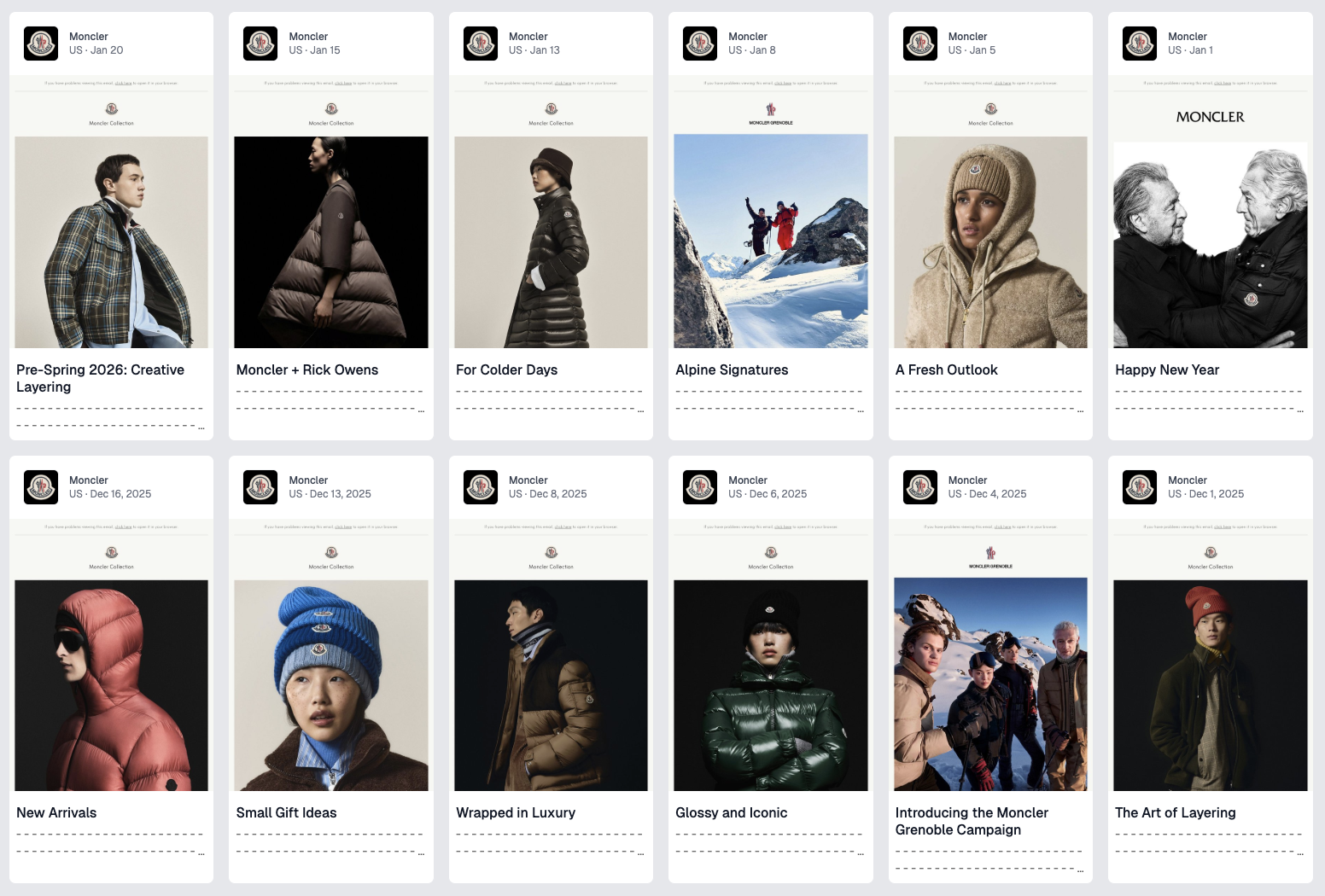
Extract from Moncler Email Marketing Library
For many luxury and premium DTC brands, CRM and email marketing are approached with caution.
The concerns are familiar:
We don’t want to look promotional.
We don’t want to fatigue our audience.
We don’t want to risk losing subscribers we worked hard to acquire.
These are valid questions, but they are often framed around the wrong assumption: that email marketing itself is the risk. In reality, most of the risk lies in how CRM is understood and how email is used, not in the channel itself. Across consulting and business research, one point is remarkably consistent: email remains one of the most effective and controllable channels in direct-to-consumer commerce. Firms like McKinsey & Company have repeatedly highlighted the role of first-party data and direct relationships in building long-term customer value, particularly as paid media becomes more volatile and privacy regulations reduce third-party tracking.
Similarly, insights shared by Boston Consulting Group emphasise that brands with strong customer data foundations outperform those relying primarily on acquisition-driven growth. Email is not positioned as a promotional lever, but as a relationship infrastructure. In other words, email is not about pushing messages out it is about maintaining a direct line back to the customer.
One of the most common misconceptions is that CRM exists to “send more emails.”
In practice, CRM is a decision-making system:
Who should hear from the brand
When communication is relevant
What type of message adds value rather than noise
Consulting frameworks around customer lifecycle management consistently show that relevance reduces frequency pressure. When brands understand where a customer is in their journey, they communicate less indiscriminately, not more. For luxury brands, this distinction is critical. A well-structured CRM does not increase exposure, it increases precision.
Fear of unsubscribes frequently leads brands to reduce communication to a minimum. But research from ecommerce and digital strategy platforms such as Harvard Business Review suggests that disengaged subscribers represent a greater long-term risk than visible opt-outs. Subscribers rarely leave because a brand communicates.
They leave because:
Messages feel repetitive
Content lacks context or relevance
The brand shows up without a clear point of view
From a CRM perspective, unsubscribes are feedback. Silence provides none.
Luxury audiences are often assumed to be “fragile” or easily alienated. Yet studies referenced by platforms like Salesforce show that high-value customers expect brands to recognise them, remember them, and communicate with intent. What they resist is not frequency, but generic communication.
CRM allows brands to replace blanket messaging with:
Contextual storytelling
Purposeful touchpoints
Controlled cadence based on behavior, not assumptions
This is not about adopting mass-market tactics. It is about applying the same discipline to communication that luxury brands already apply to product, service, and experience design. In DTC ecommerce, email is often evaluated on short-term performance metrics. But consulting perspectives increasingly position it as a continuity channel, one that sustains brand presence between moments of purchase. When brands step away from email out of caution, they often unintentionally hand over the relationship to paid media, platforms, or resellers.
CRM and email are how DTC brands retain control of:
Narrative
Timing
Customer memory
Reframing the Question
The most useful question for luxury brands is not:
“How do we avoid being salesy?”
It is:
“How do we communicate with the same intention and clarity we apply to everything else?”
CRM and email marketing do not threaten brand equity. Poorly designed communication does. Used correctly, CRM does not increase noise, it reduces it and email does not diminish exclusivity.
Here a list of luxury brands and their historical email newsletter library: