
Unit Economics: How to Price Your Products
Throughout the years as a consultant it has become ever more evident that one crucial aspect of businesses is being overlooked as a potential blocker to profitable growth. Brands, at times, operate with limited visibility into their product pricing, which leads to decisions that support revenue growth but can harm margins. Getting pricing right determines directly whether your brand can grow sustainably.
In larger firms the term used is, unit economics, which essentially means breaking down the costs for each product to see how it contributes to all the other business costs. This does not only include the cost of the materials and production and shipping, but also marketing, office rent, salaries, packaging, etc.
We’ll explore how you can get a better understanding of your costs and ultimately how to best price your products, using unit economics.
Before you can price correctly you’ll need full visibility across your entire cost structure. Pricing should not only be based on products cost (COGS = cost of good sold) but should also include the following:
Cost of Goods Sold (COGS): Materials (Fabric, Trimming, etc.), Manufacturing, Duties, Warehouse Shipping
Variable Costs: Customer Shipping, Packaging, Payment Fees, Returns, Discounts
Customer Acquisition Cost (CAC): Marketing Spend
Operational Expenses: Fulfilment, Salaries, Technology
If you don’t have this information already start by collecting your outgoings in a simple spreadsheet to create some clarity. To note, some of the above costs will be averages and percentages (for example, Payment fees are usually approx, 2.5% of the retail price).
Your pricing should absorb all of these costs so that scaling your business will result in profits and not losses. Your newest and absolute favourite word in the future should be ‘contribution margin’. The contribution margin determines how much each sale contributes to covering your costs and how much profit it generates.
Contribution Margin = Retail Price - Costs
Here is a practical example for pricing an apparel product:
Step 1: Understand your costs (per unit)
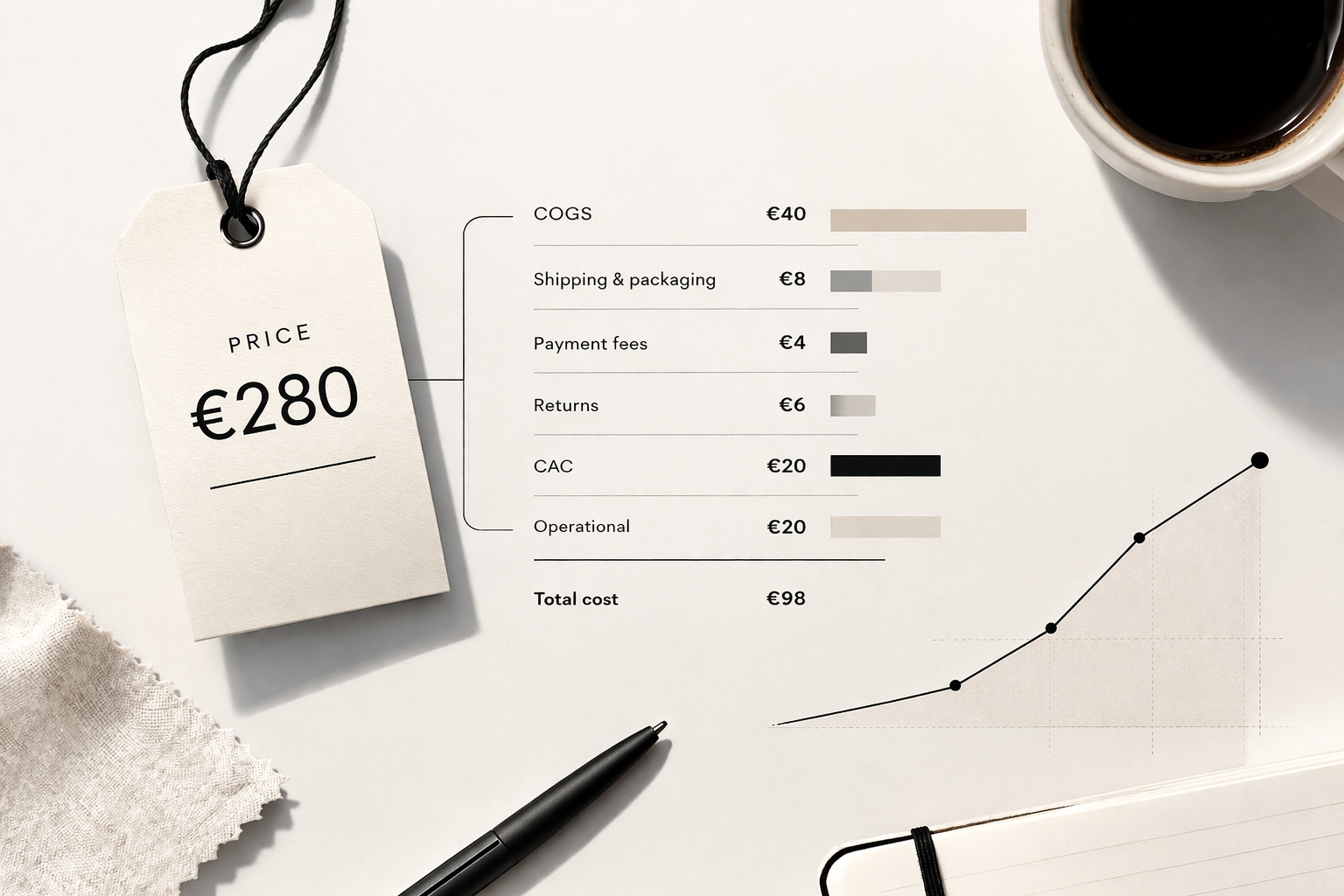
COGS: €40
Shipping & Packaging: €8
Payment Fees: €4
Returns Provisions: €6
CAC: €20
Operational Expenses: €20
Total Costs: €98
Step 2: Define your target contribution margin:
The industry suggests between 50 - 70% but let’s assume 65% for this example.
In order to calculate the retail price we’ll apply the following calculation.
Retail Price = Total Cost / (1 - Target Contribution Margin)
€98 / (1 - 0.65) = €280
This retail price ensures you cover all your costs and are able to produce a good profit to continue expanding your business. Once we also introduce wholesale pricing we would have to consider the following.
Step 3: Defning your wholesale pricing:
Wholesale introduces a different cost dynamic and retailers typically require a 2.2 - 2.5x markup.
Let’s assume that we are working with a 2.4x markup, your Wholesale Price calculation would be:
Retail Price / Markup = Wholesale Price
€280 / 2.4 = €116.67 (Rounded up to €177)
Step 4: Confirm wholesale viability:
Your wholesale contribution margin would be calculated as following:
Wholesale Price - Costs = Wholesale Contribution Margin
€117 - €98 = €19
This is distinctively lower than the contribution margin (profit) you make from selling directly to customer, however for wholesale you will be able to reduce the costs slightly as you will not have to factor in CAC for example that would reduce £20 in the example, you could also remove returns costs as you and your fulfilment centre would not be directly affected with handling those, as well as payment fees would be reduced, as well as individual order handling and shipping costs.
You may instead have consider other costs such as showrooms or agents commissions, trade fairs, sometimes new wholesale accounts request a percentage discount, as well as long payment terms (NET 30/60/90). If payment terms are long and inventory has been purchased with debt than interest incurred will have to be factored in.
The unit economics exercise it is not there to help decide on one sales channel over the other, but knowing and deciding how each channel positively contributes to the overall profitability of the company.
Common pricing mistakes look like this:
Pricing based on competitors, it is great to use this as a benchmark but use the unit economics exercise to decide if this would be a profitable way forward.
Over-discounting; discounts can be a great way to attract new customers but they do come with a cost greater than the reduced margin contribution, you’re attracting a discount customer, these tend to be less loyal than customers that base their decision on perceived value.
Ignoring CAC; CAC is a benchmark you can set within your pricing, how much am I willing to spend to acquire a single new customer, once you have a target and start advertising on Meta and Google for example you will see if this realistic or if you need to adjust the cost.
Scaling before knowing how to price your products
Whilst unit economics is important from a finance aspect, the best way to justify any price is through value based pricing, that’s what you communicate to the market through positioning.
Value is communicated through the following:
What problem your product solves
How your brand is different from others
What your customers are willing to pay
Once you have perceived value your customers are less price sensitive, you are able to improve your margins and your brand starts gaining trust, which is by far the most valuable currency in the market.